
Indian companies' overseas expansion plans are holding strong despite geopolitical tensions in West Asia, driven by structural factors like supply-chain diversification, free trade agreements, and market expansion, according to Ajay Sharma, managing director and head of banking at HSBC India.

The US and India are collaborating to de-risk global supply chains for artificial intelligence technologies, particularly in semiconductor manufacturing and critical minerals processing. This partnership is facilitated through the US-led Pax Silica initiative, which aims to address over-concentration issues and single points of failure in supply chains, fostering a resilient global economy.

'Our leaders, including Mallikarjun Kharge and Rahul Gandhi, are in touch with all Opposition parties, including the DMK and the AAP.'

The US-China rapprochement, however tenuous, is not without implications for India. Both China and Pakistan have become closer to the US, notes Ambassador T P Sreenivasan.

'The flip side of this is that he won't hesitate to call out India if he thinks its policies are hurting US economic interests or border US foreign policy goals.'

Amid rising tensions in West Asia, China is urging all parties to cease military operations, following Trump's appeal for help in securing the Strait of Hormuz.

'After the Galwan clash, the rules of engagement changed with the army commanders allowed to use any means at their disposal as they deem fit for tactical operations.'

AI-driven job disruption, rising debt, shrinking savings and a changing global economy are reshaping India's middle class. Saurabh Mukherjea discusses jobs, entrepreneurship, investing and the future of India's economic growth on THE REDIFF PODCAST.

Russian President Vladimir Putin and Chinese President Xi Jinping have reaffirmed their commitment to dismantling global hegemonism and building a 'multipolar world' during high-level talks in Beijing.

Chinese President Xi Jinping has arrived in Pyongyang for his first official visit in seven years, meeting with North Korean leader Kim Jong-un to reaffirm their long-standing friendship and pledge further development of bilateral relations amidst Pyongyang's deepening military ties with Moscow and China's assertions against Japan's 'new militarism'.

'The BNP's election manifesto lists grievances against India, mirroring the attitude of past BNP governments.' 'Political parties have been careful not to say bad things about China.'

US Secretary of State Marco Rubio met with Pakistan's Foreign Minister Ishaq Dar amid American demand that countries mediating the peace talks with Iran join the Abraham Accords and establish diplomatic and economic ties with Israel.

'They talked bad about our leaders. They said India was a dead economy. They were not sensitive to the Indian psyche.'
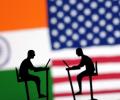
India and the US have reported positive progress in recent trade talks in Washington, agreeing to maintain engagement to finalise a bilateral trade agreement, which now requires recalibration following new US tariffs.
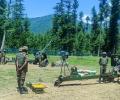
'India's security challenges are no longer confined to the Line of Control or the Line of Actual Control.'
'They also span cyber networks, economic systems, information warfare, technology ecosystems, maritime routes, and internal social cohesion.'

The boundary mess between India and Nepal needs a solution in a manner as mentioned by Nepal's Foreign Minister Shishir Khanal: 'On evidence not emotions', counsels Lieutenant General Shakti Gurung (retd).
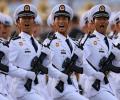
China's latest defence budget surges to $275 billion, fueling its ambitious military modernisation program and intensifying geopolitical dynamics in the region.

The US has seized an oil tanker, 'Skywave', linked to Iran in the Indian Ocean, as part of efforts to disrupt Iran's oil shipments and enforce sanctions. The vessel was part of a network transporting sanctioned Iranian crude oil, with the seizure occurring amid heightened tensions between Washington and Tehran.

Vietnam is an emerging regional power and a closer relationship with Hanoi is closely aligned with Prime Minister Narendra Modi's Act East Policy, points out Dr Rajaram Panda.

'India should understand that we are not going to make the same mistakes with India that we made with China 20 years ago.'

India has joined the US-led 'Pax Silica' alliance, aimed at building a resilient supply chain for critical minerals and artificial intelligence, marking a significant step in strengthening bilateral ties and fostering economic security.

Iranian Foreign Minister Abbas Araghchi is in India for a BRICS foreign ministers' meeting, where discussions will focus on the escalating crisis in West Asia and its impact on global energy supply chains.

Border trade between India and China through the Lipulekh Pass in Uttarakhand's Pithoragarh district is set to resume this year after a six-year hiatus due to the COVID-19 pandemic.

India has expressed strong concern over the targeting of commercial shipping in the Strait of Hormuz during the West Asia conflict, urging for the restoration of unimpeded navigation and global commerce.

Through his commitment to democratic norms, debate, dissent and constitutionalism, Jawaharlal Nehru helped ensure that parliamentary democracy took deep root in independent India. Utkarsh Mishra evaluates Nehru's 17 years as India's first prime minister, examining his role in nation-building, democratic institution-building, economic planning, scientific advancement and foreign policy.

US President Donald Trump received a red carpet welcome in Beijing for talks with Chinese President Xi Jinping on trade, the Iran war, and other key issues. The visit underscores the importance both nations place on their relationship amid ongoing tensions.

Spokesperson of the Ministry of Foreign Affairs of China, Lin Jian, said on Wednesday that China supports Iran in maintaining its stability, adding that Beijing has always opposed the interference in other countries' internal affairs and the use of force in international relations.

China has reaffirmed its territorial claims over the Shaksgam Valley, dismissing India's objections to infrastructure projects in the area. The Chinese Foreign Ministry spokesperson stated that the territory is part of China and its activities there are beyond reproach.

'When we start describing somebody as an enemy that is the start of politics and emotion after which no business can take place.' 'We need to get out of this, allow Indian businessmen to do business with China.'

The agreement was to disengage from remaining standoff sites along the Line of Actual Control (LAC), two days before a meeting between Chinese President Xi Jinping and Prime Minister Narendra Modi on the sidelines of the BRICS Summit.
David Perdue said in a post on X that the US-India relationship delivers real results through close cooperation in diverse areas, including defence, energy and through Quad engagement.

'We won not (only) because we were able to carry out long-range precision strikes.' 'That is, of course, one of the reasons but we had better situational awareness about what's happening than Pakistan.'

Phunchuk Stobdan's forte was candour and strong views on India's defence. Naturally, India's adversaries were in awe of him, fearing his views and unyielding stand on boundary issues, remembers Tarun Vijay.
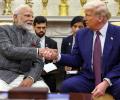
The new US national security strategy signals a retreat from global dominance while reaffirming continuity in India's role in Indo-Pacific security and Quad cooperation, points out former foreign secretary Shyam Saran.

Indian security agencies have continued efforts to reinforce the Siliguri Corridor through improved infrastructure, faster mobilisation capability and diversified connectivity routes to the north east.
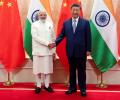
'China's basic purpose of taking the Shaksgam Valley was access to the Indian Ocean.'

The closure of the Strait of Hormuz has disrupted some 20 per cent of the global flows but even if it opens, damages to production facilities in the region will take time to repair, points out Sunita Narain.

There are enough people at the top decision-making level in Tehran who are still willing to negotiate, provided Trump can create the right setting for the negotiation to acquire a dynamic of its own, points out Ambassador M K Bhadrakumar.
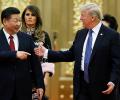
'We have incredible cards, but I don't want to play those cards.' 'If I play those cards, that would destroy China.'

India should not stay on the margins of this initiative. There should be a serious debate about what would be in India's best interests asserts former foreign secretary Shyam Saran.
